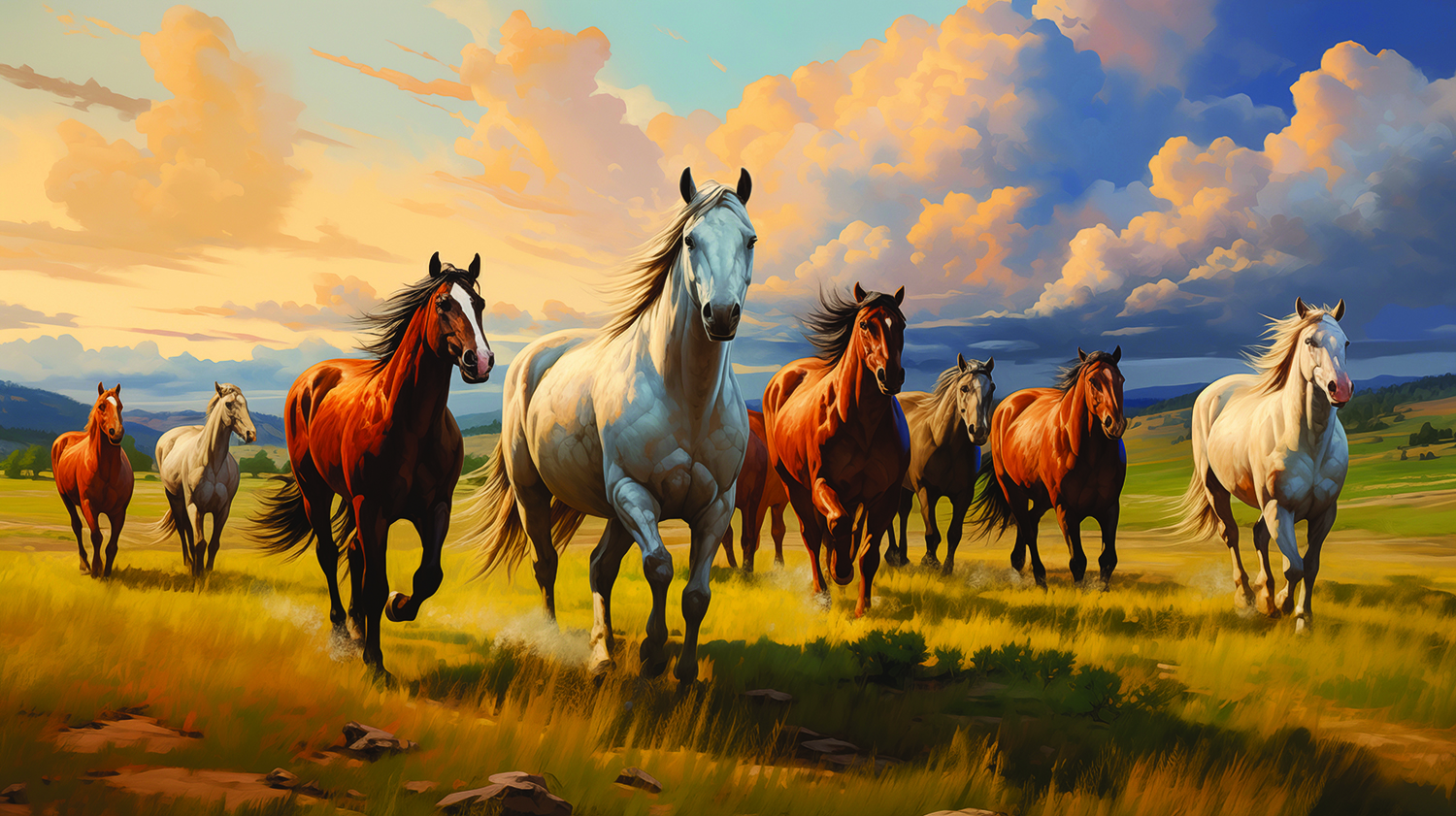
 The American mustang is descended from horses Spaniards brought to North America in the 1500’s. The terms “wild horse” and “mustang” are used interchangeably. However, "wild horse” also includes horses whose bloodline has never been domesticated. The American mustang is descended from horses Spaniards brought to North America in the 1500’s. The terms “wild horse” and “mustang” are used interchangeably. However, "wild horse” also includes horses whose bloodline has never been domesticated.
Velma Bronn Johnston, born March 5, 1912, grew up on a ranch in Nevada at a time when mustangs living in the western United States were on the verge of extinction. Her nickname, “Wild Horse Annie,” is a tribute to her efforts to preserve this national treasure.
What Annie did for the mustang was was extraordinary. But what is truly remarkable is that she transformed the narrative. She re-wrote the story of what the wild horse is all about!
The prevailing narrative is always the power behind the power. Narrative bestows “divinity” to the bloodline of kings. Narratives ignite wars. Narratives determines who becomes president, and what political policies are most desirable.
The prevailing narrative in the first half of the 20th century was that mustangs were a nuisance. Their herds competed for pasture land which many people thought belonged to cattle and other domestic livestock. Wild horses were viewed as having nothing to contribute to the newly industrialized world, other than to be a source for pet food and meat for international markets.
In the 1930’s the U.S. Government authorized removal of wild horses from public ranges. Massive roundups were conducted using trucks and planes, inhumane methods that went unopposed. Such roundups, along with hunting and habitat loss, caused the numbers of wild horses and burros to dwindle from 2 million at the turn of the century to an estimated 25,000 in 1950! At this rate, wild horses were destined to disappear from the face of America.
Annie’s ranch life instilled in her a love and respect for animals. As a child, she often caught glimpses of mustang herds that roamed not far from her home. In 1950 Annie witnessed a blood trail coming out of a truck trailer crammed full of mustangs headed for the slaughterhouse. The blood was from a colt who had been trampled to death inside the trailer.
Annie realized that she could no longer stand idly by and watch such abuse take place. She believed the wild horse represented an invaluable aspect of the history of the American West. As a secretary for an insurance agency in Reno, Nevada, Annie had the skills to research legislation and existing laws. She pulled hard facts together and made presentations to various socio-economic organizations.
During that time the nickname “Wild Horse Annie” was hurled at her, intended as an insult by opponents of her cause. But she embraced the name as an honorary title.
Annie set up a letter writing campaign to Congress, and she had the savvy to engage school children in the process.. The campaign fostered a new narrative, one that honored the horse’s contribution to the settling of the American West.
In 1959, Congress passed the Wild Horse Annie Act (P.L. 85-234) which banned the used of motorized vehicles and the practice of poisoning water holes to capture or kill wild horses. Then in 1971, the United States Wild Free-Roaming Horse and Burro Act (P.L.92-1925) mandated the protection of these animals as “a national heritage species” and placed management of mustang herds on public lands under the federal Bureau of Land Management (BLM.)
Management of wild horses under the BLM has been far less than ideal. The BLM continues to use helicopters for roundups, and some horses who were once free-roaming are forced to live in holding pens for up to three years. Issues with herd management, such as fertility control, designation of suitable protected reserves and private lands, adoption programs, training programs — all present unmet challenges.
But without Annie, the prevailing narrative would likely have led to the extinction of the wild horse.
Thanks to Annie, the federal government put out this new narrative: “Congress finds and declares that wild free roaming horses and burros are living symbols of the historic and pioneering spirit of the West … It is the policy of Congress that wild free roaming horses and burros shall be protected …”
- Linda Boston Franke, editor |